lunes, 19 de abril de 2010

Pencak Silat y La Mujer Guerrera

En Indonesia, las aventuras de mujeres guerreras se representan a menudo en formas de teatro tradicional, como el kulit wayang (títeres de cuero) y wayang orang (marionetas humanas). En la historia de Mahabarata, Srikandi es una mujer guerrera que usa su flechas y mata a varios gigantes que simbolizan. Esta historia de las epopeyas hindúes sirve como orientación a la población de Java y es el símbolo de que de vez en cuando "Srikandi 'nacerá para defender el país.
Y, en efecto, la historia de Java está llena de ejemplos de mujeres guerreras. Desde los tiempos hindú, la mujer en Java y Bali ha cumplido funciones de liderazgo. Por ejemplo, después de llevar muchas batallas, la reina de la Sima reinó Kalingga (842 ad) y la Reina Rakryan Binihaji Parameswari Dyah Kebi gobernó el Reino Singasari (1015 ad). En tiempos más recientes, durante la Guerra de Java contra los holandeses (1825-1830) el Principe (Pangeran) Diponogoro contrató a dos mujeres como comandantes, mientras que durante la guerra de Aceh (1873 -1892) uno de los líderes más famoso fue Cut Nya'din con su rencong (Acehese kris: puñal de doble filo) luchó valientemente contra los colonialistas holandeses.
El papel combativo de la mujer también se refleja en la evolución de Pencak Silat. No podemos olvidar que las mujeres han contribuido al origen de Pencak Silat, al menos de acuerdo a varias leyendas y mitos. En Indonesia se cree que Pencak Silat fue practicado por primera vez por una mujer, que imitaba los movimientos de los animales que había visto luchando, para defenderse de su marido enojado. Por ejemplo, en la pequeña isla de Bawean, en la costa norte de Java, la leyenda dice que una mujer dominante fue el pionero de Pencak Silat y aprendió sus técnicas de algunos monos:
Rama Sukana fue al río para hacer la colada. De repente, vio en el lado del río un par de monos peleando. Uno de los monos atacado repetidamente a la otra con rumbo de un árbol mientras que el otro mono estaba saltando y moviendose a un lado para evitar los golpes. Rama Sukana detuvo sus actividades y tomó nota de las técnicas de los monos peleando. Ella era tan entusiasta que no terminó sus trabajos y llegó tarde a casa. El marido, Rama Isruna que habían estado esperando, se enfadó y trató de pegarle, pero ella utilizó las técnicas que acababa de ver de los monos para evitar el ataque del marido. Al final, Rama Istruna se cansó y le pidió a su esposa cuando había aprendido esas técnicas fantásticas. Después Rama Sukama le explicó su experiencia, el marido le pidió que se las enseñara. Ahora bien, estas técnicas se conocen como Pencak Bawean.
Historias similares también se cuentas en otras provincias de Indonesia. En el oeste de Java, el estilo Cimande, se dice que deriva de la esposa de Aba Kaher que aprendió sus técnicas de lucha de un tigre contra un mono. También en la vecina Malasia, estas historias son muy populares::
Un día en un pueblo, una ama de casa que llevaba alimentos en una cesta sobre su cabeza, fue atacada por un grupo de aves que trató de robar la comida. La mujer trató de pasar de la derecha a la izquierda y de izquierda a la derecha para evitar el ataque de los pájaros. Ella también se movía hacia adelante y hacia atrás, tratando de apartarlos con las manos. Haciendo eso, perdió el tiempo y llegó tarde a casa. Ella trató de explicarle a su marido furioso lo que había ocurrido, pero él no lo aceptó. La atacó y ella tuvo que defenderse con los mismos movimientos que sólo había practicado con las aves. El marido no pudo tocarla, finalmente se cansó, y finalmente le pidió que le enseñara las técnicas que ella había aprendido. Con dedicación, practicó con su mujer y desarrolló lo que hoy se conoce como silat seni. (Tuan Tuan Ismail Soh 1991:36-37)
Las mujeres no sólo están presentes en los mitos, sino que activamente practican y enseñan Pencak Silat. Algunas de ellas también son ampliamente reconocidos por sus conocimientos y habilidades. Las más famosas hoy en día son Ibu Soekedja, pendekar del Perguruan Pencak Silat Reksa Diri, Bandung y Ibu Enny Rukmini Sekarningrat, Guru Besar Himpunan Pencak Silat Panglipur oeste de Java, la más grande y uno de los más respetados perguruan en Java Occidental, con sucursales en los Países Bajos , Japón y Vietnam. En su persona se combinan Pencak Silat y habilidades combativas como la siguiente historia:
En marzo de 1949, cuando los colonialistas holandeses volvieron de nuevo a bombardear Yogyakarta, Enny Rukmini se unió al batallón Pangeran Papak y luchó contra ellos en los distritos de Wanaraja y Garut. Para defender la ciudad capital de Yogyakarta se unió a la larga marcha de Garut a Yogyakarta (unos 400 km.) Con el Rukman Batalyon Mayor. Dado que las armas eran limitadas y de todos modos ella no sabía cómo usarlas, se mostró satisfecho con el uso de la espada (Golok) en combinación con Pencak Silat jurus y kebal Ilmu como sus armas en el campo de batalla.
Después de la guerra, regresó a casa en Garut y se hizo cargo de su padre el perguron Pencak Silat Panglipur. Después se fue a Bandung para reunir a los estudiantes de su padre y empezar a entrenar Pencak Silat juntos. El primer entrenamiento fue en su casa, en una pequeña calle todavía se llama Banda Panglipur en honor de esta escuela de Pencak Silat importante. A partir de entonces Ibu Enny Rukmini Sekarningrat reconstruí el Perguron Pencak Silat Panglipur y más en general Pencak Silat en Java Occidental, junto con otros como pendekar Pak Uca, UHO Pak, Sapari Hadji, y Saleh M.. Ella fue instrumento en la promoción de Pencak Silat en las escuelas y la universidad, y muy avanzada Pencak Silat Seni (arte). Ella fue la primera en reformar drásticamente seni Pencak Silat y en utilizarlo como una forma de actuación, al cambiar el uniforme de Pencak Silat negro con uniformes de colores brillantes.
Sus ideas innovadoras a menudo provocaron críticas de los grupos más conservadores, pero finalmente recibió el reconocimiento oficial en 1953 cuando su grupo actuó en la 1 ª Conferencia Asia-Africa en Bandung. Ibu Enny fue también la primera en apoyar IPSI en el desarrollo de competiciones de Pencak Silat Seni. Por el momento, ella es uno de los "ancianos" (sesepuh) del IPSI y reconocida como el líder o gurú pendekar Besar de la renombrada Himpunan Pencak Silat Panglipur, la escuela Pencak Silat más grande en el oeste de Java. Con sus 85 años todavía está totalmente dedicada al desarrollo de Pencak Silat en Java Occidental y más en general en el mundo.
Parece entonces que las mujeres han desempeñado un gran papel en el desarrollo de Pencak Silat desde el principio hasta hoy. Su contribución debe ser atesorada y destacada, en un esfuerzo para hacer Pencak Silat hoy en día más accesible a las mujeres y mejorar su posición en las organizaciones institucionalizadas Pencak Silat, como IPSI y PERSILAT.

domingo, 11 de abril de 2010

jueves, 1 de abril de 2010

Traditional weapons - BADIK


The Badik is a traditional dagger which originates from the coastal tribes of southern Sulawesi such as the Bugis and the Makasarese. Because of their trade relationship with other tribes, it has reached the coasts of Sumatra, the Malay Peninsula and to some extent Borneo, Java and Bali.
The blade can be in iron, steel or pamor. It is also believed the Badik has mysterious power such as for the Keris.
The Bugis Badik has a 90° pistol grip with round edges, whereas the Makasarese badik has a 45° conic pistol grip. The Sumatra and Peninsula Badik is very similar to the Bugis.
The Badik is also part of the traditional clothing and is wear by the bride for the wedding ceremony in Sulawesi or Sumatra. It is worn in front of the stomach into the pleats of the sarong.
One of the traditional way of fighting with the Badik is to have the two opponents enclosed in sarong with a Badik in a hand while the other hand holds the sarong with no possibility to escape.

Traditional weapons - MANDAU

Mandau is the traditional weapon for the Dayak people of Borneo. However, Mandau is mostly ceremonial, and a less elaborate version is used as an everyday practical tool.
Associated with the Headhunting Ceremony, where people would gather to attack other tribes, and gather heads to be used in various festivities, mandau is both a work of art in itself and a formidable weapon.
The blade is mostly made of tempered metals, with exquisite vineworks and inlaid brass. The hilt is made from animal horns, such as deer's horns, although some variations with human bones and fragrant wood also have been found. Both the hilt and scabbard are elaborately carved and plumed. Details of carvings vary from tribe to tribe, but mostly depict creatures or, if human bones were used, anthropomorphic deities.

miércoles, 31 de marzo de 2010

THE KRIS or KERIS

The kris or keris is a distinctive, asymmetrical dagger indigenous to Indonesia. Both a weapon and spiritual object, krisses are often considered to have an essence or presence, with some blades possessing good luck and others possessing bad. In 2005, UNESCO gave the title Masterpiece of the Oral and Intangible Heritage of Humanity to Kris of Indonesia.
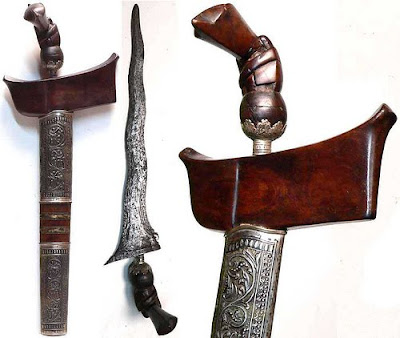
El Kris o Keris es una daga distinctiva, asimetrica indigena de Indonesia. Tanto un arma como un objeto espiritual, se cree a menudo que el keris tenga una esencia o presencia, con algunas lamas que traen buena o mala suerte. En el 2005, la UNESCO ha otorgado el título de Obra Maestra del Oral e Intangible Herencia de la Humanidad al Kris de Indonesia.

The term keris had a Javanese origin, although the etymology is uncertain. The term "keris" may have originated from the old Javanese word ngiris which means "to wedge" or "to sliver." Kris is a European rendering of this Javanese term.
El temino Keris tiene origen de Java, aunque su etimología sea incierta. El termino Keris puede que tenga sus origenes en la antigua palabra "ngris" que significa "clavar" o "astillar". Kris es la trasliteración de este término de Java.

A kris has a cranked hilt that serves as a support for stabbing strike. It allows the strength of the wrist to add pressure on the blade while slashing and cutting. A kris only offers minimal protection for the hand by the broad blade at the hilt. In rare cases, a kris may have its blade forged so the blade's axis lies at an angle to the hilt's axis. The intention is to get the blade automatically turning to slip past the ribs. This works poorly and makes the weapon less durable.

La empuñadura del kris es doblada y eso le da suporte para la acción de clavar. Esto permite añadir a la fuerza de la muñeca presión sobre la lama en la empuñadura. El kris ofrece poca protección para la mano, en la parte ancha de la empuñadura. En raros casos, la lama puede ser forjada de forma que el axis de la lama se encuentre en angulo con el axis de la empuñadura. La intención es la de hacer que la lama gire automaticamente para clavarse entre las costillas. Esto funciona poco y hace que el arma no tenga larga duración.

One of the most famous folk stories from Java describes a legendary kris empu (bladesmith), called Mpu Gandring, and his impatient customer, Ken Arok. Ken Arok wanted to order a powerful Kris to kill the chieftain of Tumapel, Tunggul Ametung. Ken Arok eventually stabbed the old bladesmith to death because he kept delaying the scheduled completion of the kris, which Ken Arok had probably ordered several months before. Dying, the bladesmith prophesied that the unfinished or incomplete kris would kill seven men, including Ken Arok.

Una de las más conocidas historias de Java cuenta de un kris empu (forjador de kris), llamado Mpu Gandring, y su cliente impaciente, Ken Arok. Ken Arok quería un poderoso Kris para matar el jefe de Tumapel, Tunggul Ametung. Ken Arok finalmente apuñaló el viejo artesano a muerte porque seguía posponiendo la fabricación del kris, que Ken Arok había pedido quizás muchos meses antes. Muriendose, el forjador profetizó que el no acabado kris mataría a siete hombres, inclusive Ken Arok.

The prophecy finally came true, with for men enlisted as the kris' first death roll, including Mpu Gandring himself, the Adipati of Tumapel Tunggul Ametung, Kebo Ijo (to whom Ken Arok lent the blade and accused to be the murderer of Tunggul Ametung), and Ken Arok himself, later. The unfinished kris of Mpu Gandring then left disappeared.

La profecía se cumplió: cuatro hombres murieron como primera misión del kris, inclusive el mismo Mpu Gandring, el Adipati de Tumapel Tunggul Ametung, Kebo Ijo (a quien Ken Arok prestó el kris y acusó de ser el asesino de Tunggul Ametung), y el mismo Ken Arok más tarde. El no acabado kris de Mpu Gandring desapareció y no se volvió a encontrar nunca más.

martes, 30 de marzo de 2010

HISTORY OF THE KARAMBIT


Since before recorded time, different cultures around the globe developed different tools based on their needs. Some developed superior fishing tools, while others developed tools for planting crops. Tool design and application are a direct result of era and geography. A seaside dwelling tribe would develop different tools than would a mountainous or plains tribe. When various peoples migrated from one geographical location to another they brought with them their tools and way of life - sometimes peacefully, as in migration, and other times by war, as in the case of conquest.
According to the oral tradition that was passed down from master to student for centuries, prior to 1280 AD, most of West Java was part of the indigenous Pajajaran kingdom. The Badui tribe of West Java, the aboriginal people of Sunda, considered to be the ethnic group of the Pajajaran, lived relatively peacefully until the coming of the Majapahit empire (circa 1351 AD). At that time the Badui tribe quickly migrated to the rugged mountainous regions of the west, brought their weapons with them and remained self-governed.

The kings of the ancient Sundanese kingdom were considered very powerful. When a king died, his subjects believed that his spirit flitted into the jungles and became the spirit of a tiger. There are two terms for the tiger that rules the jungles of West Java. One is Harimau, which is the generic Bahasay Indonesian word for tiger, and the other is Pak Macan (pronounced "Pah-mah-chahn" - sometimes anglicized and spelled Pamacan) which loosely translates to "great tiger." Thus, the great tiger is very much revered by the Sundanese.
So awed were the ancient Sunda peoples by the power and ferocity of the Pamacan, that the common blade of the people was patterned after the shape of the claw of Pamacan. This very large blade was known as Kuku Macan, or "claw of Pamacan." Literally translated as "tiger claw", the Kuku Macan was revered symbolically as well as practically employed.
Originally wielded in battle, the oversized Kuku Macan was a bit cumbersome to manipulate, so it was scaled down to smaller sizes, which augmented maneuverability. Much like the ancient European broadsword, which was eventually reduced from a two-handed heavy slashing weapon to a light single-handed thrusting weapon, various permutations of the Kuku Macan were developed based upon practical usage. As the saying goes, "Necessity is the mother of invention". Like the development of the Western dagger, the Kuku Macan blade design came in smaller sizes and eventually found itself in the smallest size - the very personalized Karambit.

The Karambit is also referred to as the Kuku Bima (literally "the claw of Bima"). Pre-12th century influence as a result of Hindus settling in Indonesian archipelago, brought the Mahabharata ("great epic of the Bharata Dynasty") and the Ramayana, (two major epics of India, valued for both high literary merit and religious inspiration), to Java. Contained within the Mahabharata is the Bagavadgita ("the Lord's song") which is the single most important religious text of Hinduism. Bima is one of the most revered characters from the Mahabrapta.
Also known as Kuku Hanuman, the magical claw, which protrudes from between the center of the hands of Bima and Hanuman - has become recognized as a symbol of the martial arts of the Indonesian archipelago, namely Pencak Silat and is often attributed as one of the roots of the overall Karambit design.

The graceful and efficient curvature of the tiger's claw (designed by mother nature) in combination with the mystical hand weapons of the ancient characters of the Mahabharata and the Ramayana - the Kuku Macan, Kuku Bima or Kuku Hanuman - where forged together with steel and bone by early village-dwellers to create the ancient Karambit. In modern times as the Karambit (now much smaller in size than its battlefield-sized ancestor) is now recognized internationally as a traditional weapon of Indonesian Pencak Silat.
When a fighter unsheathed a battlefield Karambit in ancient times, the cutting edge was almost always smeared with some type of deadly poison, which acted almost instantly upon entry into the bloodstream via laceration of the flesh. Even the smallest cut was enough to usher the poison into the bloodstream.
Knowledge and use of poisons derived from various species of poisonous frogs, snakes, scorpions and spiders were considered an essential element of a warrior's arsenal of close-quarter combative skills. These poisons rapidly accelerated death and were mostly feared for their nearly instantaneous killing power. This is another reason why Pencak Silat techniques and systems such as Sabetan and Rhikasan focus on the immobilization of the hands at close quarters.
The personal Karambit (smaller version of the battlefield Karambit) was primarily designed for targeting the nerves and joints. As a result of such a small cutting surface, most cuts cannot be made deep enough to kill someone. That is why the Karambit can be considered a personal self-defense tool. In contrast, the blade of the Karambit Besar (larger or battlefield version of the personal-sized Karambit) is longer and thus permits deeper cuts. According to the ancients, the battlefield Karambit was preferred not only for its superior length but for the fact that you could, as a result of the lengthy cutting edge, "spill the entrails of your enemies onto the ground." However, as it was in the West, with the advent of battle-worthy and functional firearms, bladed weapons became obsolete on the battlefield and relegated to the utilitarian uses of knives that we see today.

Often used as a last line of defense in ancient times when the larger Clurit was made inoperable, the smaller personal Karambit targets included the eyes, testicles, the Achilles tendon, carotid artery, biceps, forearm and wrist. A particularly nasty target of ancient times was the clavicle (collar-bone). Executed perfectly the Karambit would catch the collarbone and is then quickly turned from palm down position to palm up position which, using your body weight, would snap the bone thus rendering your enemy's weapon arm useless.
Specifically designed as a close-quarter self-defense weapon, the Karambit of old was additionally quite difficult to see in the hand due to its method of deployment and cover of the fingers. Doubly menacing was that it could not be disarmed as a result of its forefinger-grip design. It was unique to any other blade at the time as it could be used for both a medium and close fighting ranges without changing distance of the striking arm. It was also the only blade used in battle that could cut twice with a single arm stroke. All other blades of that era need one motion for one cut. The ancient battlefield Karambit was unique because:
It could not be easily seen.
It could not be easily disarmed
It could change ranges without body movement
It could deliver two strikes in a single arm motion.

Although quite a remarkable weapon, and as fierce as it looks, its primary application in this modern era is utilitarian. The multi-functionality of this tool is what truly sets it apart from the many different other types of utility knives.
Used in training by martial artists who practice the art of Pencak Silat, and in some cases used as an implement of personal defense, its small tip and blade length are not conducive to delivery of lethal blows and the Karambit cannot be used for effective thrusting and thus cannot be considered a dagger.
However, when used correctly it can deliver convincing motivation to any would-be attacker to leave you for another victim!
Originally used for personal backup, the Karambit could be employed as an "add-on" with specific styles and systems of training. For example, the Cikalong and Rhikasan systems of Mande Muda Pencak Silat, are the base systems of hand immobilization and close-quarter technique. Once you became proficient in these systems in empty-hand application, you could then easily "add on" the Karambit to your technique.
Today, although no longer used on the field of battle, the Karambit is employed as a utility tool, a martial-arts training implement and can also be used for personal protection at extreme close quarters as a last line of defense.

¿QUÉ ES EL KARAMBIT? WHAT IS KARAMBIT?


The Ancient Karambit - El antiguo KarambitThe Karambit (pronounced kah-rahm-bit) is a remarkable utility knife that was born in the Indonesian archipelago with roots in Malaysia and the Philippines. Akin to the Swiss Army knife of today, this was the "pocket knife" of ancient villagers. This extraordinary little personal tool was first documented to be carried around the early 11th century AD and to this very day can be seen in various remote locations throughout the Indonesian islands, parts of Malaysia and the Southern Philippine islands.
El Karambit es un cuchillo increíblemente útil nacido en el archipielago indonesio con raices en Malasia y las Filipinas. Similar al cuchillo del ejercito suiso de hoy en día, este era el cuchillo de bolsillo de los habitantes de las islas. Este extraordinario instrumento fue documentado por primera vez al principio del siglo XI AC y hasta hoy se puede encontrar en remotos lugares en las islas de Indonesia, parte de Malasia y las Filipinas.
The predominant uses of the Karambit in ancient times were similar to the uses of the European pocket knife: field work, including cutting rope; chopping fruits and vegetables; and, in some rare cases, as an exceptional personal safety weapon.
Los principales usos del Karambit en los tiempos antiguos eran similares al uso del cuchillo de bolsillo europeo: trabajo en el campo, corte de funes, colecta de frutos y verduras; y en algunos casos, como arma de defensa personal.

The Karambit as a Modern Utility Knife - El Karambit como utensilio modernoIn modern times, this utility tool still performs the same functions as its distant ancestor for such daily chores as opening packages, cutting rope, leather work, home repair, yard work, etc., and outdoor activities such as hunting, fishing, construction work, hiking, etc., and is additionally recognized as a training tool for interested martial artists for its personal-safety value.
Hoy en día, este instrumento mantiene sus funciones antiguas para las tareas diarias como abrir paquetes, cortar cuerdas, trabajar el cuero, reparaciones domesticas, trabajos en el patio, etc. y también para actividades al aire libre como caza, pesca, construcción, hiking etc, y además es un instrumento de entrenamiento para artes marciales y defensa personal.
As a utility knife it is superior to other blades as a result of a remarkable safety feature - a finger loop which prevents the blade from slipping in your hand when in use. This significantly drops the number of "cut yourself" injuries, as the blade is secured to your finger just like a pair of scissors in order that it does not slip and cut your hand.
El utilizo de este cuchillo es superior al de otros debido a su seguridad: el orificio para el dedo permite evitar que la lama llegue a la mano durante su utilizo. Esto hace disminuir significativamente las "auto-heridas", ya que el cuchillo está enganchado al dedo como unas tijeras, así que no desliza y no te corta.

The Karambit as a Martial Arts Implement - El Karambit como instrumento en las Artes MarcialesAs a martial-arts implement, it is an extraordinary ancient artifact that permits the accomplished practitioner grace, style and freedom of creative movement. Very much akin to dance-like movements, the true art of the Karambit is like ballet.
Como instrumento marcial, se trata de un magnifico artefacto que confiere gracia, estilo y libertad de movimientos al practicante. Muy parecido a los movimientos en la danza, ya que el verdadero arte del Karambit es como el ballet.

Quien soy

Mi foto
Mijas Costa, Malaga, Spain